
diff options
| author | Bobby <[email protected]> | 2022-03-12 20:41:27 -0500 |
|---|---|---|
| committer | Bobby <[email protected]> | 2022-03-12 20:41:27 -0500 |
| commit | 3c7c1582c978ebeba137096b23c7bc1fcf5dab65 (patch) | |
| tree | 5bf04231388c28ab741cc1dd742a79aabbe48b51 | |
| parent | b5c63881ba025ddd90d480e0ba512518096301ee (diff) | |
| download | luciferreeves.github.io-3c7c1582c978ebeba137096b23c7bc1fcf5dab65.tar.xz luciferreeves.github.io-3c7c1582c978ebeba137096b23c7bc1fcf5dab65.zip | |
redoing styles
| -rw-r--r-- | .gitignore | 7 | ||||
| -rw-r--r-- | 404.html | 25 | ||||
| -rw-r--r-- | CNAME | 1 | ||||
| -rw-r--r-- | Gemfile | 33 | ||||
| -rw-r--r-- | Gemfile.lock | 90 | ||||
| -rw-r--r-- | LICENSE | 674 | ||||
| -rw-r--r-- | README.md | 2 | ||||
| -rw-r--r-- | _config.yml | 58 | ||||
| -rw-r--r-- | _includes/footer.html | 7 | ||||
| -rw-r--r-- | _includes/math.html | 18 | ||||
| -rw-r--r-- | _includes/navigation.html | 11 | ||||
| -rw-r--r-- | _posts/2021-01-16-big-o-notation-explained-as-easily-as-possible.md | 72 | ||||
| -rw-r--r-- | _posts/2021-01-22-analysing-algorithms-worst-case-running-time.md | 197 | ||||
| -rw-r--r-- | _posts/2021-02-02-most-beautiful-question-of-computer-science-math.md | 93 | ||||
| -rw-r--r-- | _posts/2021-07-27-do-you-really-know-javascript.md | 234 | ||||
| -rw-r--r-- | about.md | 19 | ||||
| -rw-r--r-- | index.html | 6 |
17 files changed, 2 insertions, 1545 deletions
diff --git a/.gitignore b/.gitignore deleted file mode 100644 index 8d7b42e..0000000 --- a/.gitignore +++ /dev/null @@ -1,7 +0,0 @@ -_site -.sass-cache -.jekyll-cache -.jekyll-metadata -vendor - -.DS_Store diff --git a/404.html b/404.html deleted file mode 100644 index 086a5c9..0000000 --- a/404.html +++ /dev/null @@ -1,25 +0,0 @@ ---- -permalink: /404.html -layout: default ---- - -<style type="text/css" media="screen"> - .container { - margin: 10px auto; - max-width: 600px; - text-align: center; - } - h1 { - margin: 30px 0; - font-size: 4em; - line-height: 1; - letter-spacing: -1px; - } -</style> - -<div class="container"> - <h1>404</h1> - - <p><strong>Page not found :(</strong></p> - <p>The requested page could not be found.</p> -</div> @@ -1 +0,0 @@ -thatcomputerscientist.com
\ No newline at end of file diff --git a/Gemfile b/Gemfile deleted file mode 100644 index a2ee9ab..0000000 --- a/Gemfile +++ /dev/null @@ -1,33 +0,0 @@ -source "https://rubygems.org" -# Hello! This is where you manage which Jekyll version is used to run. -# When you want to use a different version, change it below, save the -# file and run `bundle install`. Run Jekyll with `bundle exec`, like so: -# -# bundle exec jekyll serve -# -# This will help ensure the proper Jekyll version is running. -# Happy Jekylling! -gem "jekyll", "~> 4.2.0" -# This is the default theme for new Jekyll sites. You may change this to anything you like. -gem "minima", "~> 2.5" -# If you want to use GitHub Pages, remove the "gem "jekyll"" above and -# uncomment the line below. To upgrade, run `bundle update github-pages`. -# gem "github-pages", group: :jekyll_plugins -# If you have any plugins, put them here! -group :jekyll_plugins do - gem "jekyll-feed", "~> 0.12" -end - -# Windows and JRuby does not include zoneinfo files, so bundle the tzinfo-data gem -# and associated library. -platforms :mingw, :x64_mingw, :mswin, :jruby do - gem "tzinfo", "~> 1.2" - gem "tzinfo-data" -end - -# Performance-booster for watching directories on Windows -gem "wdm", "~> 0.1.1", :platforms => [:mingw, :x64_mingw, :mswin] - -gem "jekyll-remote-theme" -gem "jekyll-paginate" -gem "kramdown" diff --git a/Gemfile.lock b/Gemfile.lock deleted file mode 100644 index 354e47e..0000000 --- a/Gemfile.lock +++ /dev/null @@ -1,90 +0,0 @@ -GEM - remote: https://rubygems.org/ - specs: - addressable (2.8.0) - public_suffix (>= 2.0.2, < 5.0) - colorator (1.1.0) - concurrent-ruby (1.1.9) - em-websocket (0.5.2) - eventmachine (>= 0.12.9) - http_parser.rb (~> 0.6.0) - eventmachine (1.2.7) - ffi (1.15.3) - forwardable-extended (2.6.0) - http_parser.rb (0.6.0) - i18n (1.8.10) - concurrent-ruby (~> 1.0) - jekyll (4.2.0) - addressable (~> 2.4) - colorator (~> 1.0) - em-websocket (~> 0.5) - i18n (~> 1.0) - jekyll-sass-converter (~> 2.0) - jekyll-watch (~> 2.0) - kramdown (~> 2.3) - kramdown-parser-gfm (~> 1.0) - liquid (~> 4.0) - mercenary (~> 0.4.0) - pathutil (~> 0.9) - rouge (~> 3.0) - safe_yaml (~> 1.0) - terminal-table (~> 2.0) - jekyll-feed (0.15.1) - jekyll (>= 3.7, < 5.0) - jekyll-paginate (1.1.0) - jekyll-remote-theme (0.4.3) - addressable (~> 2.0) - jekyll (>= 3.5, < 5.0) - jekyll-sass-converter (>= 1.0, <= 3.0.0, != 2.0.0) - rubyzip (>= 1.3.0, < 3.0) - jekyll-sass-converter (2.1.0) - sassc (> 2.0.1, < 3.0) - jekyll-seo-tag (2.7.1) - jekyll (>= 3.8, < 5.0) - jekyll-watch (2.2.1) - listen (~> 3.0) - kramdown (2.3.1) - rexml - kramdown-parser-gfm (1.1.0) - kramdown (~> 2.0) - liquid (4.0.3) - listen (3.5.1) - rb-fsevent (~> 0.10, >= 0.10.3) - rb-inotify (~> 0.9, >= 0.9.10) - mercenary (0.4.0) - minima (2.5.1) - jekyll (>= 3.5, < 5.0) - jekyll-feed (~> 0.9) - jekyll-seo-tag (~> 2.1) - pathutil (0.16.2) - forwardable-extended (~> 2.6) - public_suffix (4.0.6) - rb-fsevent (0.11.0) - rb-inotify (0.10.1) - ffi (~> 1.0) - rexml (3.2.5) - rouge (3.26.0) - rubyzip (2.3.1) - safe_yaml (1.0.5) - sassc (2.4.0) - ffi (~> 1.9) - terminal-table (2.0.0) - unicode-display_width (~> 1.1, >= 1.1.1) - unicode-display_width (1.7.0) - -PLATFORMS - universal-darwin-20 - -DEPENDENCIES - jekyll (~> 4.2.0) - jekyll-feed (~> 0.12) - jekyll-paginate - jekyll-remote-theme - kramdown - minima (~> 2.5) - tzinfo (~> 1.2) - tzinfo-data - wdm (~> 0.1.1) - -BUNDLED WITH - 2.2.21 diff --git a/LICENSE b/LICENSE deleted file mode 100644 index f288702..0000000 --- a/LICENSE +++ /dev/null @@ -1,674 +0,0 @@ - GNU GENERAL PUBLIC LICENSE - Version 3, 29 June 2007 - - Copyright (C) 2007 Free Software Foundation, Inc. <https://fsf.org/> - Everyone is permitted to copy and distribute verbatim copies - of this license document, but changing it is not allowed. - - Preamble - - The GNU General Public License is a free, copyleft license for -software and other kinds of works. - - The licenses for most software and other practical works are designed -to take away your freedom to share and change the works. By contrast, -the GNU General Public License is intended to guarantee your freedom to -share and change all versions of a program--to make sure it remains free -software for all its users. We, the Free Software Foundation, use the -GNU General Public License for most of our software; it applies also to -any other work released this way by its authors. You can apply it to -your programs, too. - - When we speak of free software, we are referring to freedom, not -price. Our General Public Licenses are designed to make sure that you -have the freedom to distribute copies of free software (and charge for -them if you wish), that you receive source code or can get it if you -want it, that you can change the software or use pieces of it in new -free programs, and that you know you can do these things. - - To protect your rights, we need to prevent others from denying you -these rights or asking you to surrender the rights. Therefore, you have -certain responsibilities if you distribute copies of the software, or if -you modify it: responsibilities to respect the freedom of others. - - For example, if you distribute copies of such a program, whether -gratis or for a fee, you must pass on to the recipients the same -freedoms that you received. You must make sure that they, too, receive -or can get the source code. And you must show them these terms so they -know their rights. - - Developers that use the GNU GPL protect your rights with two steps: -(1) assert copyright on the software, and (2) offer you this License -giving you legal permission to copy, distribute and/or modify it. - - For the developers' and authors' protection, the GPL clearly explains -that there is no warranty for this free software. For both users' and -authors' sake, the GPL requires that modified versions be marked as -changed, so that their problems will not be attributed erroneously to -authors of previous versions. - - Some devices are designed to deny users access to install or run -modified versions of the software inside them, although the manufacturer -can do so. This is fundamentally incompatible with the aim of -protecting users' freedom to change the software. The systematic -pattern of such abuse occurs in the area of products for individuals to -use, which is precisely where it is most unacceptable. Therefore, we -have designed this version of the GPL to prohibit the practice for those -products. If such problems arise substantially in other domains, we -stand ready to extend this provision to those domains in future versions -of the GPL, as needed to protect the freedom of users. - - Finally, every program is threatened constantly by software patents. -States should not allow patents to restrict development and use of -software on general-purpose computers, but in those that do, we wish to -avoid the special danger that patents applied to a free program could -make it effectively proprietary. To prevent this, the GPL assures that -patents cannot be used to render the program non-free. - - The precise terms and conditions for copying, distribution and -modification follow. - - TERMS AND CONDITIONS - - 0. Definitions. - - "This License" refers to version 3 of the GNU General Public License. - - "Copyright" also means copyright-like laws that apply to other kinds of -works, such as semiconductor masks. - - "The Program" refers to any copyrightable work licensed under this -License. Each licensee is addressed as "you". "Licensees" and -"recipients" may be individuals or organizations. - - To "modify" a work means to copy from or adapt all or part of the work -in a fashion requiring copyright permission, other than the making of an -exact copy. The resulting work is called a "modified version" of the -earlier work or a work "based on" the earlier work. - - A "covered work" means either the unmodified Program or a work based -on the Program. - - To "propagate" a work means to do anything with it that, without -permission, would make you directly or secondarily liable for -infringement under applicable copyright law, except executing it on a -computer or modifying a private copy. Propagation includes copying, -distribution (with or without modification), making available to the -public, and in some countries other activities as well. - - To "convey" a work means any kind of propagation that enables other -parties to make or receive copies. Mere interaction with a user through -a computer network, with no transfer of a copy, is not conveying. - - An interactive user interface displays "Appropriate Legal Notices" -to the extent that it includes a convenient and prominently visible -feature that (1) displays an appropriate copyright notice, and (2) -tells the user that there is no warranty for the work (except to the -extent that warranties are provided), that licensees may convey the -work under this License, and how to view a copy of this License. If -the interface presents a list of user commands or options, such as a -menu, a prominent item in the list meets this criterion. - - 1. Source Code. - - The "source code" for a work means the preferred form of the work -for making modifications to it. "Object code" means any non-source -form of a work. - - A "Standard Interface" means an interface that either is an official -standard defined by a recognized standards body, or, in the case of -interfaces specified for a particular programming language, one that -is widely used among developers working in that language. - - The "System Libraries" of an executable work include anything, other -than the work as a whole, that (a) is included in the normal form of -packaging a Major Component, but which is not part of that Major -Component, and (b) serves only to enable use of the work with that -Major Component, or to implement a Standard Interface for which an -implementation is available to the public in source code form. A -"Major Component", in this context, means a major essential component -(kernel, window system, and so on) of the specific operating system -(if any) on which the executable work runs, or a compiler used to -produce the work, or an object code interpreter used to run it. - - The "Corresponding Source" for a work in object code form means all -the source code needed to generate, install, and (for an executable -work) run the object code and to modify the work, including scripts to -control those activities. However, it does not include the work's -System Libraries, or general-purpose tools or generally available free -programs which are used unmodified in performing those activities but -which are not part of the work. For example, Corresponding Source -includes interface definition files associated with source files for -the work, and the source code for shared libraries and dynamically -linked subprograms that the work is specifically designed to require, -such as by intimate data communication or control flow between those -subprograms and other parts of the work. - - The Corresponding Source need not include anything that users -can regenerate automatically from other parts of the Corresponding -Source. - - The Corresponding Source for a work in source code form is that -same work. - - 2. Basic Permissions. - - All rights granted under this License are granted for the term of -copyright on the Program, and are irrevocable provided the stated -conditions are met. This License explicitly affirms your unlimited -permission to run the unmodified Program. The output from running a -covered work is covered by this License only if the output, given its -content, constitutes a covered work. This License acknowledges your -rights of fair use or other equivalent, as provided by copyright law. - - You may make, run and propagate covered works that you do not -convey, without conditions so long as your license otherwise remains -in force. You may convey covered works to others for the sole purpose -of having them make modifications exclusively for you, or provide you -with facilities for running those works, provided that you comply with -the terms of this License in conveying all material for which you do -not control copyright. Those thus making or running the covered works -for you must do so exclusively on your behalf, under your direction -and control, on terms that prohibit them from making any copies of -your copyrighted material outside their relationship with you. - - Conveying under any other circumstances is permitted solely under -the conditions stated below. Sublicensing is not allowed; section 10 -makes it unnecessary. - - 3. Protecting Users' Legal Rights From Anti-Circumvention Law. - - No covered work shall be deemed part of an effective technological -measure under any applicable law fulfilling obligations under article -11 of the WIPO copyright treaty adopted on 20 December 1996, or -similar laws prohibiting or restricting circumvention of such -measures. - - When you convey a covered work, you waive any legal power to forbid -circumvention of technological measures to the extent such circumvention -is effected by exercising rights under this License with respect to -the covered work, and you disclaim any intention to limit operation or -modification of the work as a means of enforcing, against the work's -users, your or third parties' legal rights to forbid circumvention of -technological measures. - - 4. Conveying Verbatim Copies. - - You may convey verbatim copies of the Program's source code as you -receive it, in any medium, provided that you conspicuously and -appropriately publish on each copy an appropriate copyright notice; -keep intact all notices stating that this License and any -non-permissive terms added in accord with section 7 apply to the code; -keep intact all notices of the absence of any warranty; and give all -recipients a copy of this License along with the Program. - - You may charge any price or no price for each copy that you convey, -and you may offer support or warranty protection for a fee. - - 5. Conveying Modified Source Versions. - - You may convey a work based on the Program, or the modifications to -produce it from the Program, in the form of source code under the -terms of section 4, provided that you also meet all of these conditions: - - a) The work must carry prominent notices stating that you modified - it, and giving a relevant date. - - b) The work must carry prominent notices stating that it is - released under this License and any conditions added under section - 7. This requirement modifies the requirement in section 4 to - "keep intact all notices". - - c) You must license the entire work, as a whole, under this - License to anyone who comes into possession of a copy. This - License will therefore apply, along with any applicable section 7 - additional terms, to the whole of the work, and all its parts, - regardless of how they are packaged. This License gives no - permission to license the work in any other way, but it does not - invalidate such permission if you have separately received it. - - d) If the work has interactive user interfaces, each must display - Appropriate Legal Notices; however, if the Program has interactive - interfaces that do not display Appropriate Legal Notices, your - work need not make them do so. - - A compilation of a covered work with other separate and independent -works, which are not by their nature extensions of the covered work, -and which are not combined with it such as to form a larger program, -in or on a volume of a storage or distribution medium, is called an -"aggregate" if the compilation and its resulting copyright are not -used to limit the access or legal rights of the compilation's users -beyond what the individual works permit. Inclusion of a covered work -in an aggregate does not cause this License to apply to the other -parts of the aggregate. - - 6. Conveying Non-Source Forms. - - You may convey a covered work in object code form under the terms -of sections 4 and 5, provided that you also convey the -machine-readable Corresponding Source under the terms of this License, -in one of these ways: - - a) Convey the object code in, or embodied in, a physical product - (including a physical distribution medium), accompanied by the - Corresponding Source fixed on a durable physical medium - customarily used for software interchange. - - b) Convey the object code in, or embodied in, a physical product - (including a physical distribution medium), accompanied by a - written offer, valid for at least three years and valid for as - long as you offer spare parts or customer support for that product - model, to give anyone who possesses the object code either (1) a - copy of the Corresponding Source for all the software in the - product that is covered by this License, on a durable physical - medium customarily used for software interchange, for a price no - more than your reasonable cost of physically performing this - conveying of source, or (2) access to copy the - Corresponding Source from a network server at no charge. - - c) Convey individual copies of the object code with a copy of the - written offer to provide the Corresponding Source. This - alternative is allowed only occasionally and noncommercially, and - only if you received the object code with such an offer, in accord - with subsection 6b. - - d) Convey the object code by offering access from a designated - place (gratis or for a charge), and offer equivalent access to the - Corresponding Source in the same way through the same place at no - further charge. You need not require recipients to copy the - Corresponding Source along with the object code. If the place to - copy the object code is a network server, the Corresponding Source - may be on a different server (operated by you or a third party) - that supports equivalent copying facilities, provided you maintain - clear directions next to the object code saying where to find the - Corresponding Source. Regardless of what server hosts the - Corresponding Source, you remain obligated to ensure that it is - available for as long as needed to satisfy these requirements. - - e) Convey the object code using peer-to-peer transmission, provided - you inform other peers where the object code and Corresponding - Source of the work are being offered to the general public at no - charge under subsection 6d. - - A separable portion of the object code, whose source code is excluded -from the Corresponding Source as a System Library, need not be -included in conveying the object code work. - - A "User Product" is either (1) a "consumer product", which means any -tangible personal property which is normally used for personal, family, -or household purposes, or (2) anything designed or sold for incorporation -into a dwelling. In determining whether a product is a consumer product, -doubtful cases shall be resolved in favor of coverage. For a particular -product received by a particular user, "normally used" refers to a -typical or common use of that class of product, regardless of the status -of the particular user or of the way in which the particular user -actually uses, or expects or is expected to use, the product. A product -is a consumer product regardless of whether the product has substantial -commercial, industrial or non-consumer uses, unless such uses represent -the only significant mode of use of the product. - - "Installation Information" for a User Product means any methods, -procedures, authorization keys, or other information required to install -and execute modified versions of a covered work in that User Product from -a modified version of its Corresponding Source. The information must -suffice to ensure that the continued functioning of the modified object -code is in no case prevented or interfered with solely because -modification has been made. - - If you convey an object code work under this section in, or with, or -specifically for use in, a User Product, and the conveying occurs as -part of a transaction in which the right of possession and use of the -User Product is transferred to the recipient in perpetuity or for a -fixed term (regardless of how the transaction is characterized), the -Corresponding Source conveyed under this section must be accompanied -by the Installation Information. But this requirement does not apply -if neither you nor any third party retains the ability to install -modified object code on the User Product (for example, the work has -been installed in ROM). - - The requirement to provide Installation Information does not include a -requirement to continue to provide support service, warranty, or updates -for a work that has been modified or installed by the recipient, or for -the User Product in which it has been modified or installed. Access to a -network may be denied when the modification itself materially and -adversely affects the operation of the network or violates the rules and -protocols for communication across the network. - - Corresponding Source conveyed, and Installation Information provided, -in accord with this section must be in a format that is publicly -documented (and with an implementation available to the public in -source code form), and must require no special password or key for -unpacking, reading or copying. - - 7. Additional Terms. - - "Additional permissions" are terms that supplement the terms of this -License by making exceptions from one or more of its conditions. -Additional permissions that are applicable to the entire Program shall -be treated as though they were included in this License, to the extent -that they are valid under applicable law. If additional permissions -apply only to part of the Program, that part may be used separately -under those permissions, but the entire Program remains governed by -this License without regard to the additional permissions. - - When you convey a copy of a covered work, you may at your option -remove any additional permissions from that copy, or from any part of -it. (Additional permissions may be written to require their own -removal in certain cases when you modify the work.) You may place -additional permissions on material, added by you to a covered work, -for which you have or can give appropriate copyright permission. - - Notwithstanding any other provision of this License, for material you -add to a covered work, you may (if authorized by the copyright holders of -that material) supplement the terms of this License with terms: - - a) Disclaiming warranty or limiting liability differently from the - terms of sections 15 and 16 of this License; or - - b) Requiring preservation of specified reasonable legal notices or - author attributions in that material or in the Appropriate Legal - Notices displayed by works containing it; or - - c) Prohibiting misrepresentation of the origin of that material, or - requiring that modified versions of such material be marked in - reasonable ways as different from the original version; or - - d) Limiting the use for publicity purposes of names of licensors or - authors of the material; or - - e) Declining to grant rights under trademark law for use of some - trade names, trademarks, or service marks; or - - f) Requiring indemnification of licensors and authors of that - material by anyone who conveys the material (or modified versions of - it) with contractual assumptions of liability to the recipient, for - any liability that these contractual assumptions directly impose on - those licensors and authors. - - All other non-permissive additional terms are considered "further -restrictions" within the meaning of section 10. If the Program as you -received it, or any part of it, contains a notice stating that it is -governed by this License along with a term that is a further -restriction, you may remove that term. If a license document contains -a further restriction but permits relicensing or conveying under this -License, you may add to a covered work material governed by the terms -of that license document, provided that the further restriction does -not survive such relicensing or conveying. - - If you add terms to a covered work in accord with this section, you -must place, in the relevant source files, a statement of the -additional terms that apply to those files, or a notice indicating -where to find the applicable terms. - - Additional terms, permissive or non-permissive, may be stated in the -form of a separately written license, or stated as exceptions; -the above requirements apply either way. - - 8. Termination. - - You may not propagate or modify a covered work except as expressly -provided under this License. Any attempt otherwise to propagate or -modify it is void, and will automatically terminate your rights under -this License (including any patent licenses granted under the third -paragraph of section 11). - - However, if you cease all violation of this License, then your -license from a particular copyright holder is reinstated (a) -provisionally, unless and until the copyright holder explicitly and -finally terminates your license, and (b) permanently, if the copyright -holder fails to notify you of the violation by some reasonable means -prior to 60 days after the cessation. - - Moreover, your license from a particular copyright holder is -reinstated permanently if the copyright holder notifies you of the -violation by some reasonable means, this is the first time you have -received notice of violation of this License (for any work) from that -copyright holder, and you cure the violation prior to 30 days after -your receipt of the notice. - - Termination of your rights under this section does not terminate the -licenses of parties who have received copies or rights from you under -this License. If your rights have been terminated and not permanently -reinstated, you do not qualify to receive new licenses for the same -material under section 10. - - 9. Acceptance Not Required for Having Copies. - - You are not required to accept this License in order to receive or -run a copy of the Program. Ancillary propagation of a covered work -occurring solely as a consequence of using peer-to-peer transmission -to receive a copy likewise does not require acceptance. However, -nothing other than this License grants you permission to propagate or -modify any covered work. These actions infringe copyright if you do -not accept this License. Therefore, by modifying or propagating a -covered work, you indicate your acceptance of this License to do so. - - 10. Automatic Licensing of Downstream Recipients. - - Each time you convey a covered work, the recipient automatically -receives a license from the original licensors, to run, modify and -propagate that work, subject to this License. You are not responsible -for enforcing compliance by third parties with this License. - - An "entity transaction" is a transaction transferring control of an -organization, or substantially all assets of one, or subdividing an -organization, or merging organizations. If propagation of a covered -work results from an entity transaction, each party to that -transaction who receives a copy of the work also receives whatever -licenses to the work the party's predecessor in interest had or could -give under the previous paragraph, plus a right to possession of the -Corresponding Source of the work from the predecessor in interest, if -the predecessor has it or can get it with reasonable efforts. - - You may not impose any further restrictions on the exercise of the -rights granted or affirmed under this License. For example, you may -not impose a license fee, royalty, or other charge for exercise of -rights granted under this License, and you may not initiate litigation -(including a cross-claim or counterclaim in a lawsuit) alleging that -any patent claim is infringed by making, using, selling, offering for -sale, or importing the Program or any portion of it. - - 11. Patents. - - A "contributor" is a copyright holder who authorizes use under this -License of the Program or a work on which the Program is based. The -work thus licensed is called the contributor's "contributor version". - - A contributor's "essential patent claims" are all patent claims -owned or controlled by the contributor, whether already acquired or -hereafter acquired, that would be infringed by some manner, permitted -by this License, of making, using, or selling its contributor version, -but do not include claims that would be infringed only as a -consequence of further modification of the contributor version. For -purposes of this definition, "control" includes the right to grant -patent sublicenses in a manner consistent with the requirements of -this License. - - Each contributor grants you a non-exclusive, worldwide, royalty-free -patent license under the contributor's essential patent claims, to -make, use, sell, offer for sale, import and otherwise run, modify and -propagate the contents of its contributor version. - - In the following three paragraphs, a "patent license" is any express -agreement or commitment, however denominated, not to enforce a patent -(such as an express permission to practice a patent or covenant not to -sue for patent infringement). To "grant" such a patent license to a -party means to make such an agreement or commitment not to enforce a -patent against the party. - - If you convey a covered work, knowingly relying on a patent license, -and the Corresponding Source of the work is not available for anyone -to copy, free of charge and under the terms of this License, through a -publicly available network server or other readily accessible means, -then you must either (1) cause the Corresponding Source to be so -available, or (2) arrange to deprive yourself of the benefit of the -patent license for this particular work, or (3) arrange, in a manner -consistent with the requirements of this License, to extend the patent -license to downstream recipients. "Knowingly relying" means you have -actual knowledge that, but for the patent license, your conveying the -covered work in a country, or your recipient's use of the covered work -in a country, would infringe one or more identifiable patents in that -country that you have reason to believe are valid. - - If, pursuant to or in connection with a single transaction or -arrangement, you convey, or propagate by procuring conveyance of, a -covered work, and grant a patent license to some of the parties -receiving the covered work authorizing them to use, propagate, modify -or convey a specific copy of the covered work, then the patent license -you grant is automatically extended to all recipients of the covered -work and works based on it. - - A patent license is "discriminatory" if it does not include within -the scope of its coverage, prohibits the exercise of, or is -conditioned on the non-exercise of one or more of the rights that are -specifically granted under this License. You may not convey a covered -work if you are a party to an arrangement with a third party that is -in the business of distributing software, under which you make payment -to the third party based on the extent of your activity of conveying -the work, and under which the third party grants, to any of the -parties who would receive the covered work from you, a discriminatory -patent license (a) in connection with copies of the covered work -conveyed by you (or copies made from those copies), or (b) primarily -for and in connection with specific products or compilations that -contain the covered work, unless you entered into that arrangement, -or that patent license was granted, prior to 28 March 2007. - - Nothing in this License shall be construed as excluding or limiting -any implied license or other defenses to infringement that may -otherwise be available to you under applicable patent law. - - 12. No Surrender of Others' Freedom. - - If conditions are imposed on you (whether by court order, agreement or -otherwise) that contradict the conditions of this License, they do not -excuse you from the conditions of this License. If you cannot convey a -covered work so as to satisfy simultaneously your obligations under this -License and any other pertinent obligations, then as a consequence you may -not convey it at all. For example, if you agree to terms that obligate you -to collect a royalty for further conveying from those to whom you convey -the Program, the only way you could satisfy both those terms and this -License would be to refrain entirely from conveying the Program. - - 13. Use with the GNU Affero General Public License. - - Notwithstanding any other provision of this License, you have -permission to link or combine any covered work with a work licensed -under version 3 of the GNU Affero General Public License into a single -combined work, and to convey the resulting work. The terms of this -License will continue to apply to the part which is the covered work, -but the special requirements of the GNU Affero General Public License, -section 13, concerning interaction through a network will apply to the -combination as such. - - 14. Revised Versions of this License. - - The Free Software Foundation may publish revised and/or new versions of -the GNU General Public License from time to time. Such new versions will -be similar in spirit to the present version, but may differ in detail to -address new problems or concerns. - - Each version is given a distinguishing version number. If the -Program specifies that a certain numbered version of the GNU General -Public License "or any later version" applies to it, you have the -option of following the terms and conditions either of that numbered -version or of any later version published by the Free Software -Foundation. If the Program does not specify a version number of the -GNU General Public License, you may choose any version ever published -by the Free Software Foundation. - - If the Program specifies that a proxy can decide which future -versions of the GNU General Public License can be used, that proxy's -public statement of acceptance of a version permanently authorizes you -to choose that version for the Program. - - Later license versions may give you additional or different -permissions. However, no additional obligations are imposed on any -author or copyright holder as a result of your choosing to follow a -later version. - - 15. Disclaimer of Warranty. - - THERE IS NO WARRANTY FOR THE PROGRAM, TO THE EXTENT PERMITTED BY -APPLICABLE LAW. EXCEPT WHEN OTHERWISE STATED IN WRITING THE COPYRIGHT -HOLDERS AND/OR OTHER PARTIES PROVIDE THE PROGRAM "AS IS" WITHOUT WARRANTY -OF ANY KIND, EITHER EXPRESSED OR IMPLIED, INCLUDING, BUT NOT LIMITED TO, -THE IMPLIED WARRANTIES OF MERCHANTABILITY AND FITNESS FOR A PARTICULAR -PURPOSE. THE ENTIRE RISK AS TO THE QUALITY AND PERFORMANCE OF THE PROGRAM -IS WITH YOU. SHOULD THE PROGRAM PROVE DEFECTIVE, YOU ASSUME THE COST OF -ALL NECESSARY SERVICING, REPAIR OR CORRECTION. - - 16. Limitation of Liability. - - IN NO EVENT UNLESS REQUIRED BY APPLICABLE LAW OR AGREED TO IN WRITING -WILL ANY COPYRIGHT HOLDER, OR ANY OTHER PARTY WHO MODIFIES AND/OR CONVEYS -THE PROGRAM AS PERMITTED ABOVE, BE LIABLE TO YOU FOR DAMAGES, INCLUDING ANY -GENERAL, SPECIAL, INCIDENTAL OR CONSEQUENTIAL DAMAGES ARISING OUT OF THE -USE OR INABILITY TO USE THE PROGRAM (INCLUDING BUT NOT LIMITED TO LOSS OF -DATA OR DATA BEING RENDERED INACCURATE OR LOSSES SUSTAINED BY YOU OR THIRD -PARTIES OR A FAILURE OF THE PROGRAM TO OPERATE WITH ANY OTHER PROGRAMS), -EVEN IF SUCH HOLDER OR OTHER PARTY HAS BEEN ADVISED OF THE POSSIBILITY OF -SUCH DAMAGES. - - 17. Interpretation of Sections 15 and 16. - - If the disclaimer of warranty and limitation of liability provided -above cannot be given local legal effect according to their terms, -reviewing courts shall apply local law that most closely approximates -an absolute waiver of all civil liability in connection with the -Program, unless a warranty or assumption of liability accompanies a -copy of the Program in return for a fee. - - END OF TERMS AND CONDITIONS - - How to Apply These Terms to Your New Programs - - If you develop a new program, and you want it to be of the greatest -possible use to the public, the best way to achieve this is to make it -free software which everyone can redistribute and change under these terms. - - To do so, attach the following notices to the program. It is safest -to attach them to the start of each source file to most effectively -state the exclusion of warranty; and each file should have at least -the "copyright" line and a pointer to where the full notice is found. - - <one line to give the program's name and a brief idea of what it does.> - Copyright (C) <year> <name of author> - - This program is free software: you can redistribute it and/or modify - it under the terms of the GNU General Public License as published by - the Free Software Foundation, either version 3 of the License, or - (at your option) any later version. - - This program is distributed in the hope that it will be useful, - but WITHOUT ANY WARRANTY; without even the implied warranty of - MERCHANTABILITY or FITNESS FOR A PARTICULAR PURPOSE. See the - GNU General Public License for more details. - - You should have received a copy of the GNU General Public License - along with this program. If not, see <https://www.gnu.org/licenses/>. - -Also add information on how to contact you by electronic and paper mail. - - If the program does terminal interaction, make it output a short -notice like this when it starts in an interactive mode: - - <program> Copyright (C) <year> <name of author> - This program comes with ABSOLUTELY NO WARRANTY; for details type `show w'. - This is free software, and you are welcome to redistribute it - under certain conditions; type `show c' for details. - -The hypothetical commands `show w' and `show c' should show the appropriate -parts of the General Public License. Of course, your program's commands -might be different; for a GUI interface, you would use an "about box". - - You should also get your employer (if you work as a programmer) or school, -if any, to sign a "copyright disclaimer" for the program, if necessary. -For more information on this, and how to apply and follow the GNU GPL, see -<https://www.gnu.org/licenses/>. - - The GNU General Public License does not permit incorporating your program -into proprietary programs. If your program is a subroutine library, you -may consider it more useful to permit linking proprietary applications with -the library. If this is what you want to do, use the GNU Lesser General -Public License instead of this License. But first, please read -<https://www.gnu.org/licenses/why-not-lgpl.html>. @@ -1,2 +1,4 @@ # luciferreeves.github.io Personal Website + +-- Under Construction -- diff --git a/_config.yml b/_config.yml deleted file mode 100644 index d2c786a..0000000 --- a/_config.yml +++ /dev/null @@ -1,58 +0,0 @@ -# Welcome to Jekyll! -# -# This config file is meant for settings that affect your whole blog, values -# which you are expected to set up once and rarely edit after that. If you find -# yourself editing this file very often, consider using Jekyll's data files -# feature for the data you need to update frequently. -# -# For technical reasons, this file is *NOT* reloaded automatically when you use -# 'bundle exec jekyll serve'. If you change this file, please restart the server process. -# -# If you need help with YAML syntax, here are some quick references for you: -# https://learn-the-web.algonquindesign.ca/topics/markdown-yaml-cheat-sheet/#yaml -# https://learnxinyminutes.com/docs/yaml/ -# -# Site settings -# These are used to personalize your new site. If you look in the HTML files, -# you will see them accessed via {{ site.title }}, {{ site.email }}, and so on. -# You can create any custom variable you would like, and they will be accessible -# in the templates via {{ site.myvariable }}. - -title: that computer scientist -email: [email protected] -description: "" -baseurl: "" # the subpath of your site, e.g. /blog -url: "" # the base hostname & protocol for your site, e.g. http://example.com -twitter_username: lucifercreeves -github_username: luciferreeves - -# Build settings -remote_theme: chesterhow/tale -markdown: kramdown -mathjax: true -permalink: /:title -paginate: 5 -plugins: - - jekyll-feed - - jekyll-paginate - - jekyll-remote-theme - -# Exclude from processing. -# The following items will not be processed, by default. -# Any item listed under the `exclude:` key here will be automatically added to -# the internal "default list". -# -# Excluded items can be processed by explicitly listing the directories or -# their entries' file path in the `include:` list. -# -# exclude: -# - .sass-cache/ -# - .jekyll-cache/ -# - gemfiles/ -# - Gemfile -# - Gemfile.lock -# - node_modules/ -# - vendor/bundle/ -# - vendor/cache/ -# - vendor/gems/ -# - vendor/ruby/ diff --git a/_includes/footer.html b/_includes/footer.html deleted file mode 100644 index 798e6b2..0000000 --- a/_includes/footer.html +++ /dev/null @@ -1,7 +0,0 @@ -<footer> - <span> - © <time datetime="{{ site.time }}">{{ site.time | date: '%Y' }}</time>, that computer scientist. - <br> - View <a href="https://github.com/luciferreeves/luciferreeves.github.io">Source Code</a> on GitHub. Hosted by <a href="https://pages.github.com">GitHub Pages.</a> - </span> -</footer> diff --git a/_includes/math.html b/_includes/math.html deleted file mode 100644 index d8697fc..0000000 --- a/_includes/math.html +++ /dev/null @@ -1,18 +0,0 @@ -<script type="text/x-mathjax-config"> - MathJax.Hub.Config({ - jax: ["input/TeX","input/MathML","output/SVG", "output/CommonHTML"], - extensions: ["tex2jax.js","mml2jax.js","MathMenu.js","MathZoom.js", "CHTML-preview.js"], - TeX: { - extensions: ["AMSmath.js","AMSsymbols.js","noErrors.js","noUndefined.js"] - }, - tex2jax: { - inlineMath: [ ['$','$'], ["\\(","\\)"] ], - displayMath: [ ['$$','$$'], ["\\[","\\]"] ], - processEscapes: true, - processEnvironments: true - }, - "HTML-CSS": { availableFonts: ["TeX"] } - }); - </script> -<script type="text/javascript" - src="https://cdn.mathjax.org/mathjax/latest/MathJax.js?config=TeX-AMS_HTML-full"></script>
\ No newline at end of file diff --git a/_includes/navigation.html b/_includes/navigation.html deleted file mode 100644 index 119434e..0000000 --- a/_includes/navigation.html +++ /dev/null @@ -1,11 +0,0 @@ -<nav class="nav"> - <div class="nav-container"> - <a href="{{ site.baseurl }}/"> - <h2 class="nav-title">{{ site.title }}</h2> - </a> - <ul> - <li><a href="{{ site.baseurl }}/">Posts</a></li> - <li><a href="{{ 'https://github.com/luciferreeves' }}">Github Profile</a></li> - </ul> - </div> - </nav>
\ No newline at end of file diff --git a/_posts/2021-01-16-big-o-notation-explained-as-easily-as-possible.md b/_posts/2021-01-16-big-o-notation-explained-as-easily-as-possible.md deleted file mode 100644 index c446163..0000000 --- a/_posts/2021-01-16-big-o-notation-explained-as-easily-as-possible.md +++ /dev/null @@ -1,72 +0,0 @@ ---- -layout: post -title: "Big O Notation - explained as easily as possible" -date: 2021-01-16 00:00:00 +0530 -author: Priyansh -tags: data-structures algorithms computer-science -usemathjax: true ---- -{% include math.html %} - -Data Structures and Algorithms is about solving problems efficiently. A bad programmer solves their problems inefficiently and a really bad programmer doesn't even know why their solution is inefficient. So, the question is, *How do you rank an algorithm's efficiency?* - -> If you want to learn the math involved with the Big O, read [Analysing Algorithms: Worst Case Running Time](../analysing-algorithms-worst-case-running-time). - -The simple answer to that question is the **Big O Notation**. How does that work? Let me explain! - -Say you wrote a function which goes through every number in a list and adds it to a *total_sum* variable. - -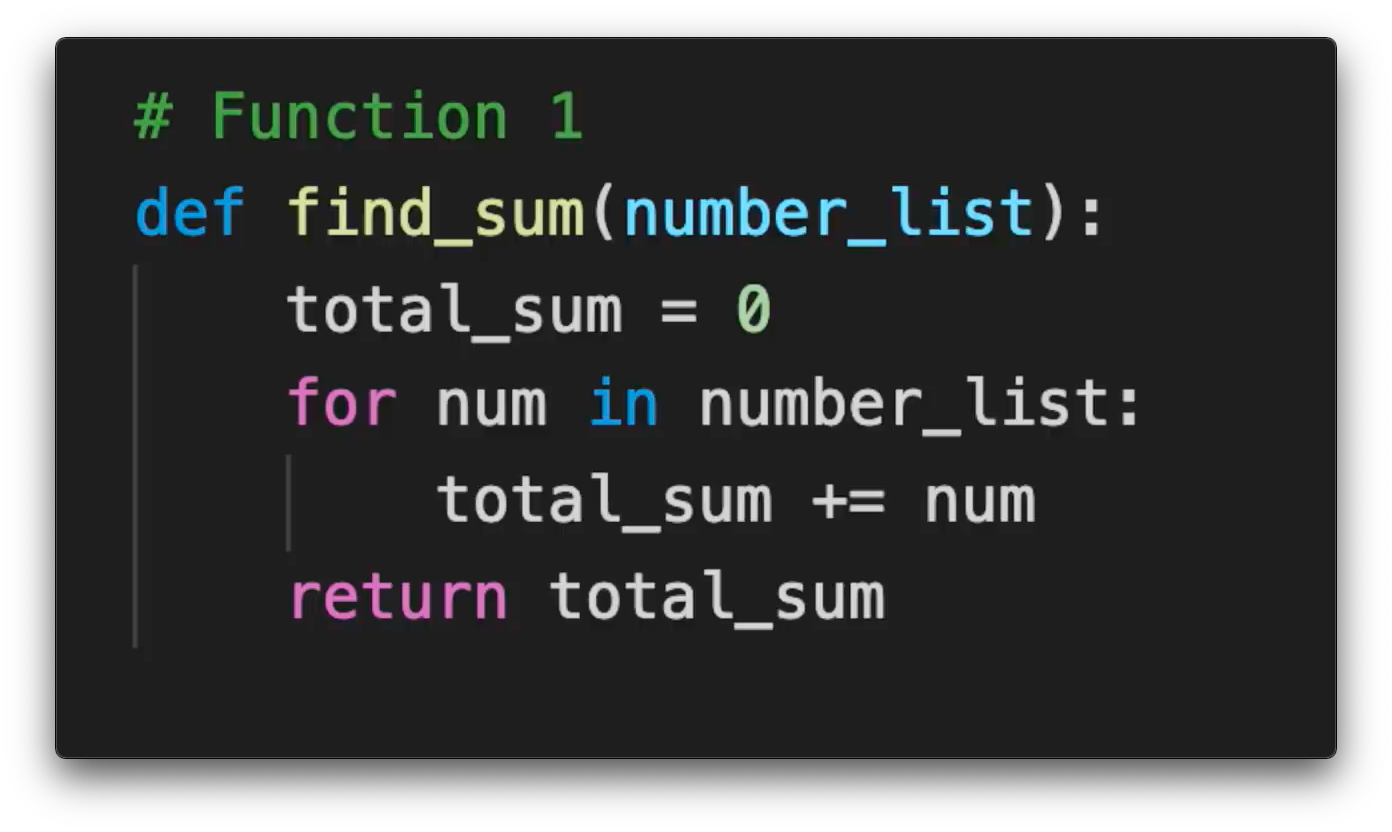 - -If you consider "addition" to be 1 operation then running this function on a list of 10 numbers will cost 10 operations, running it on a list of 20 numbers costs 20 operations and similarly running it on a list of n numbers costs the *length of list* (n) operations. - -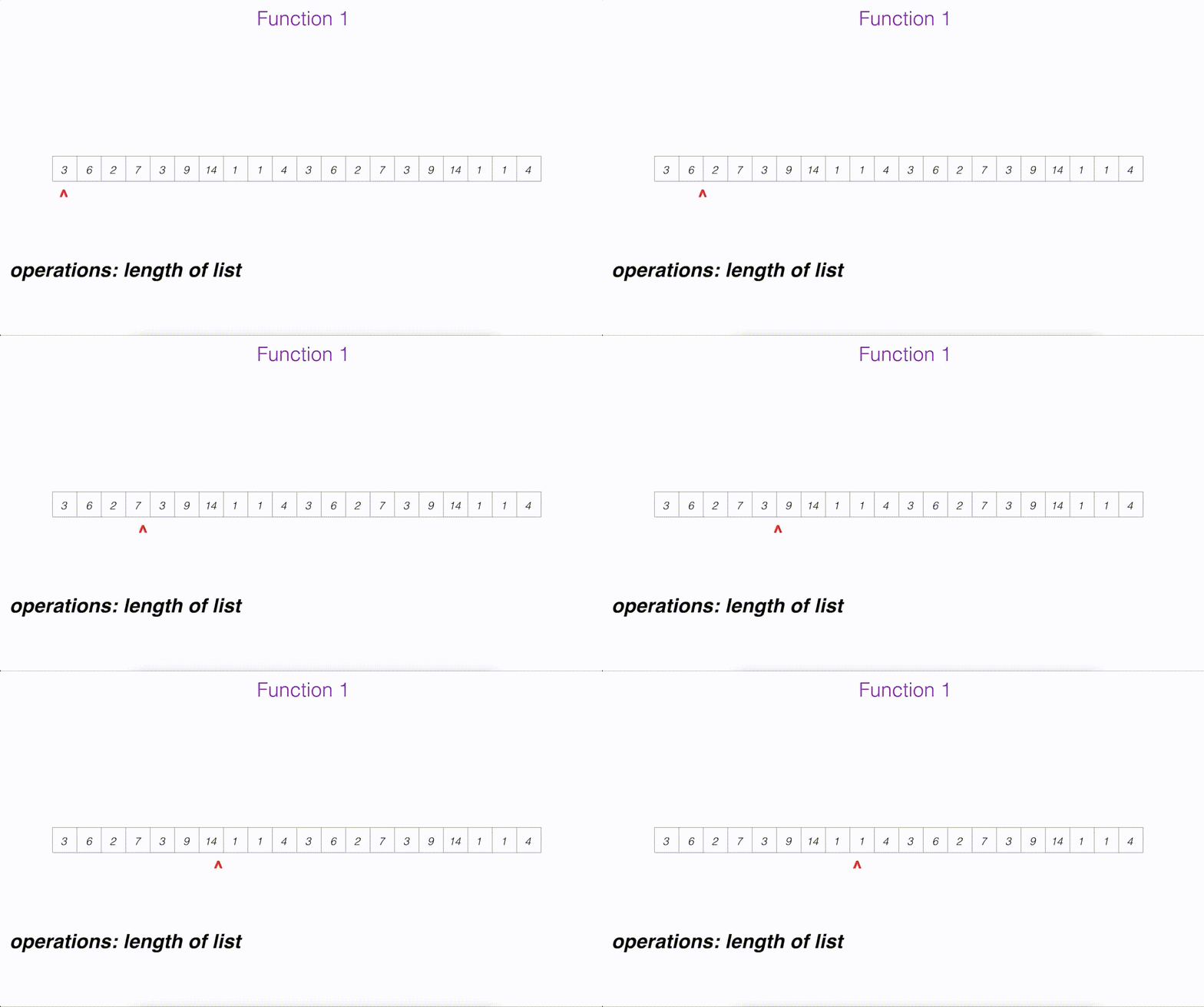 - -Now let's assume you wrote another function that would return the first number in a list. - -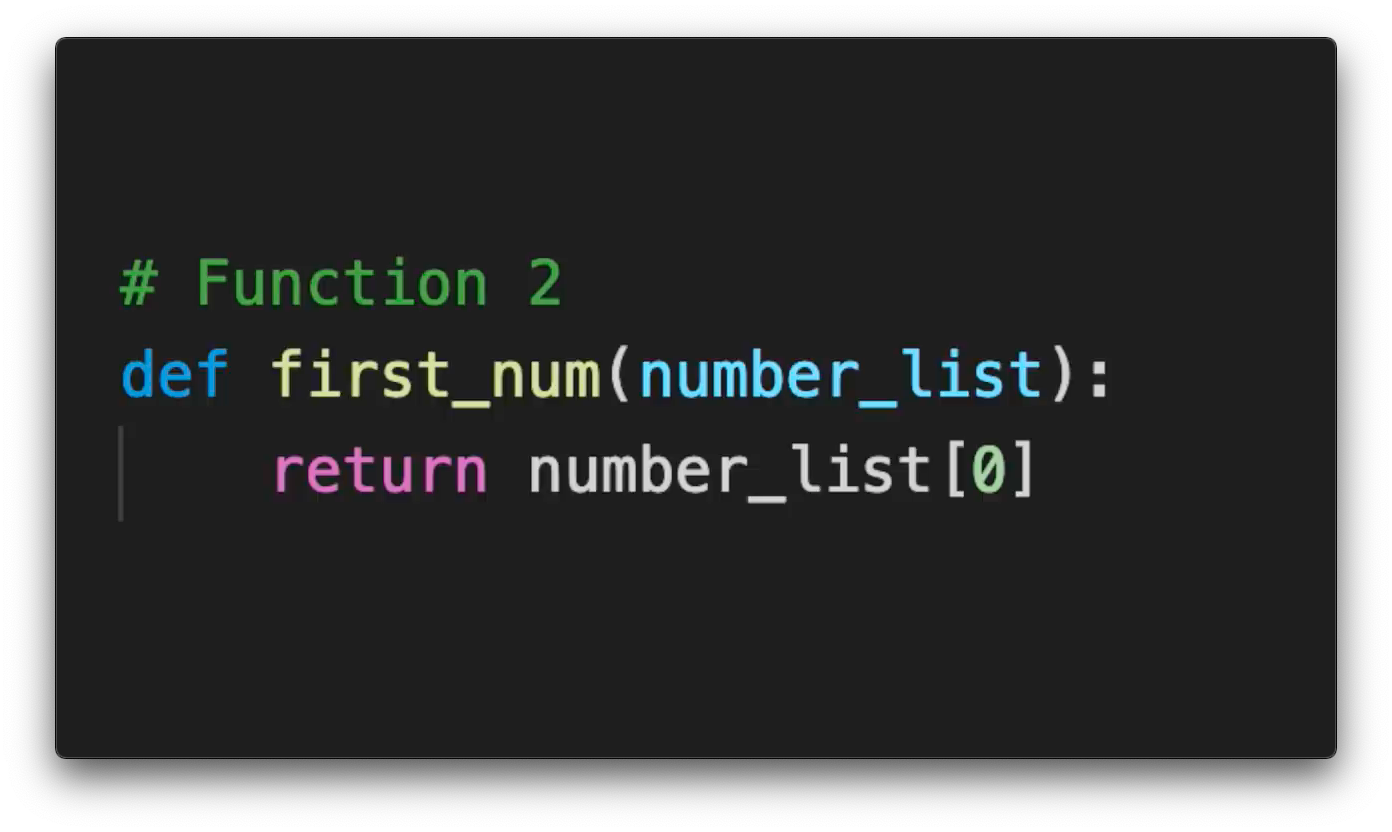 - -Now, no matter how large this list is, this function will never cost more than one operation. Fairly, these two algorithms have different **time complexity** or *relationship between growth of input size and growth of operations executed*. We communicate these time complexities using ***Big O Notation***. - -> Big O Notation is a mathematical notation used to classify algorithms according to how their run time or space requirements grow as the input size grows. - -Referring to the complexities as *'**n**'*, common complexities (ranked from good to bad) are: - -- Constant - **O(1)** -- Logarithmic **O(log n)** -- Linear - **O(n)** -- n log n - **O(n log n)** -- Quadratic - **O(n²)** -- Exponential - **O(2ⁿ)** -- Factorial - **O(n!)** - -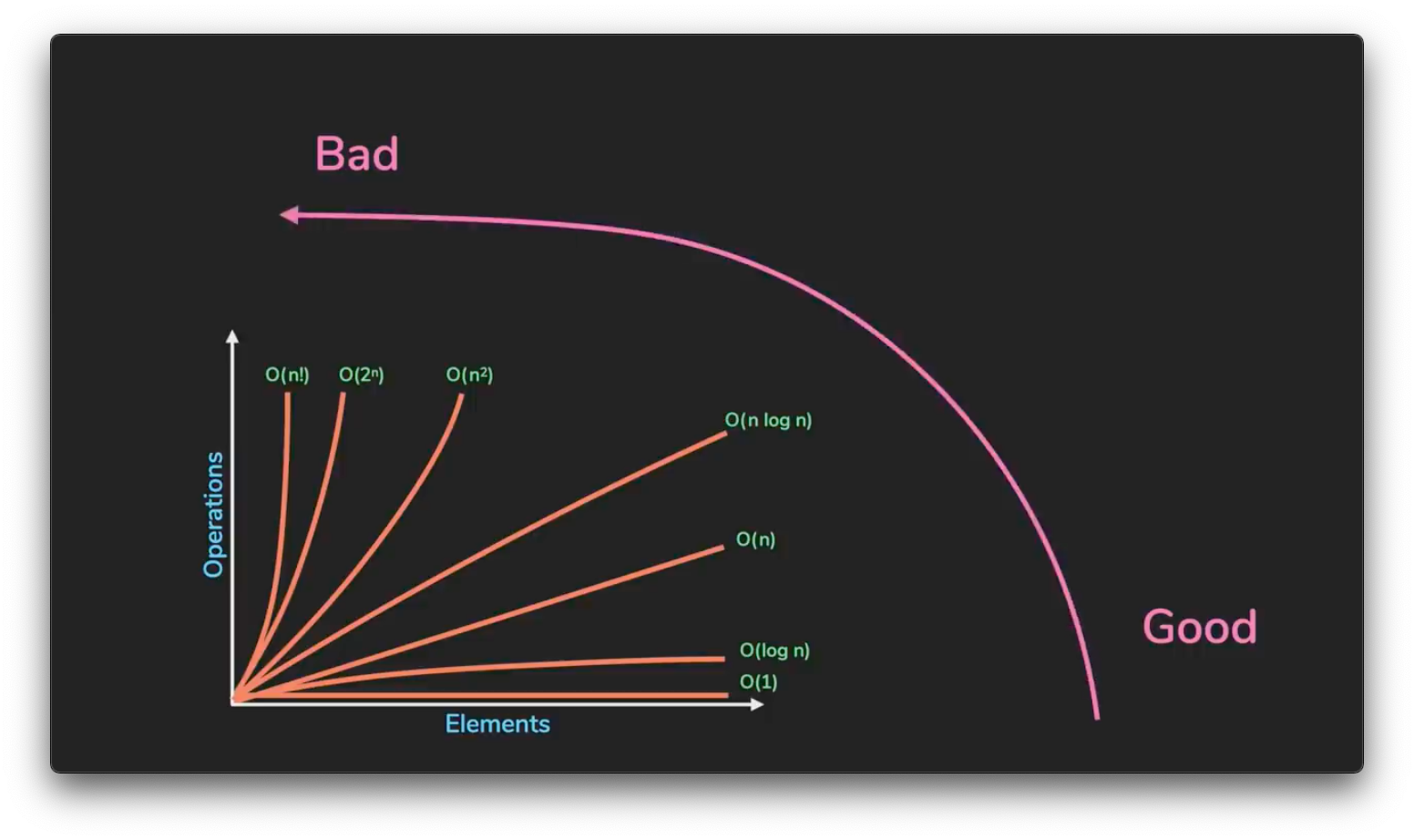 - -Our first algorithm runs in *O(n)*, meaning its operations grew in a linear relationship with the input size - in this case, the amount of numbers in the list. Our second algorithm is not dependent on the input size at all - so it runs in constant time. -Let's take a look at how many operations a program has to execute in function with an input size of *n = 5 vs n = 50*. - -| | n = 5 | n = 50 | -|----------------|-------|------------------| -| **O(1)** | 1 | 1 | -| **O(log n)** | 4 | 6 | -| **O(n)** | 5 | 50 | -| **O(n log n)** | 20 | 300 | -| **O(n²)** | 25 | 2500 | -| **O(2ⁿ)** | 32 | 1125899906842624 | -| **O(n!)** | 120 | 3.0414093e+64 | - -It might not matter when the input is small, but this gap gets very dramatic as the input size increases. - -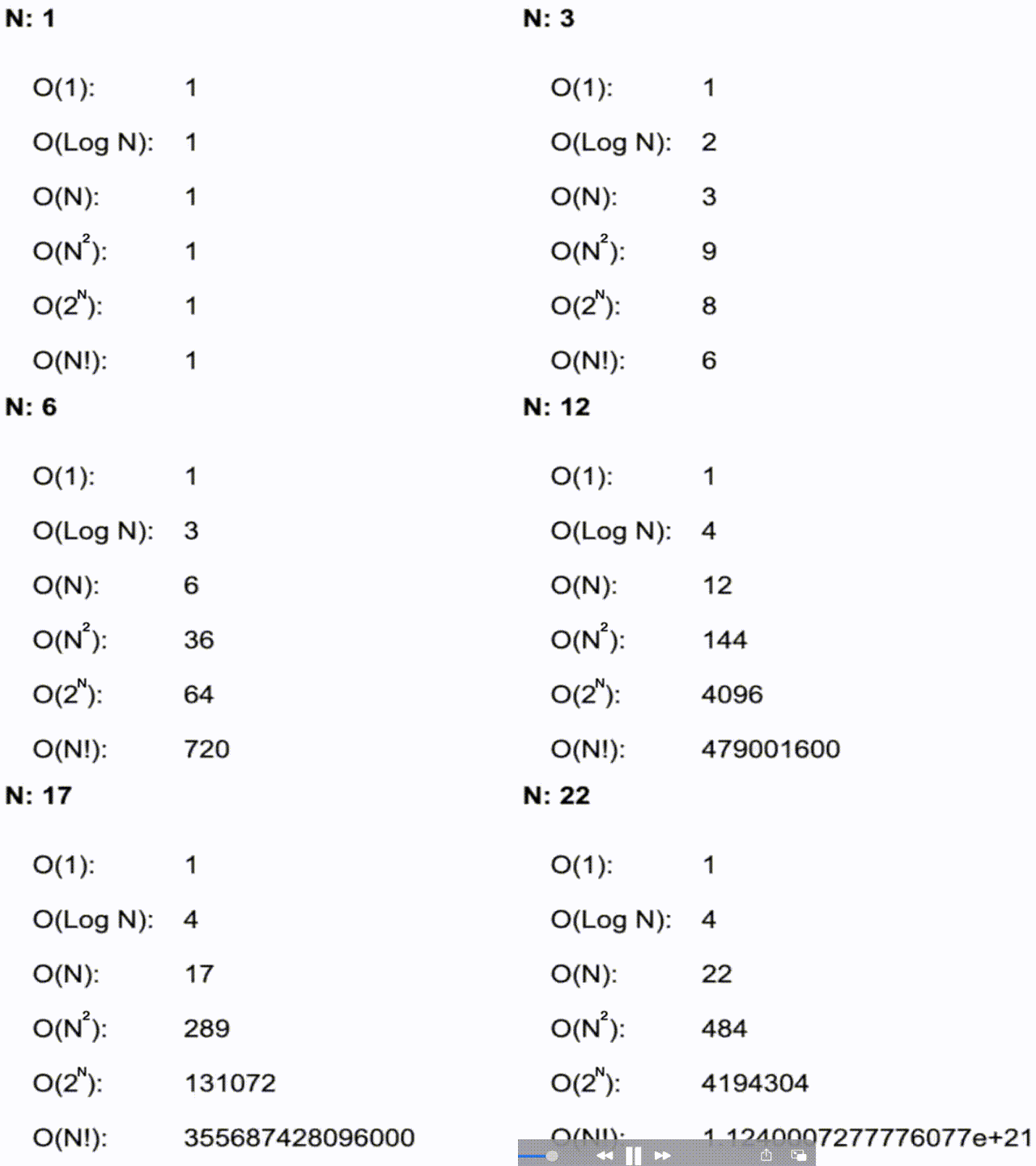 - -If n were 10000, a function that runs in *log(n)* would only take 14 operations and a function that runs in *n!* would set your computer on fire! - -For Big O Notation, we *drop constants* so *O(10.n)* and *O(n/10)* are both equivalent to *O(n)* because the graph is still linear. - -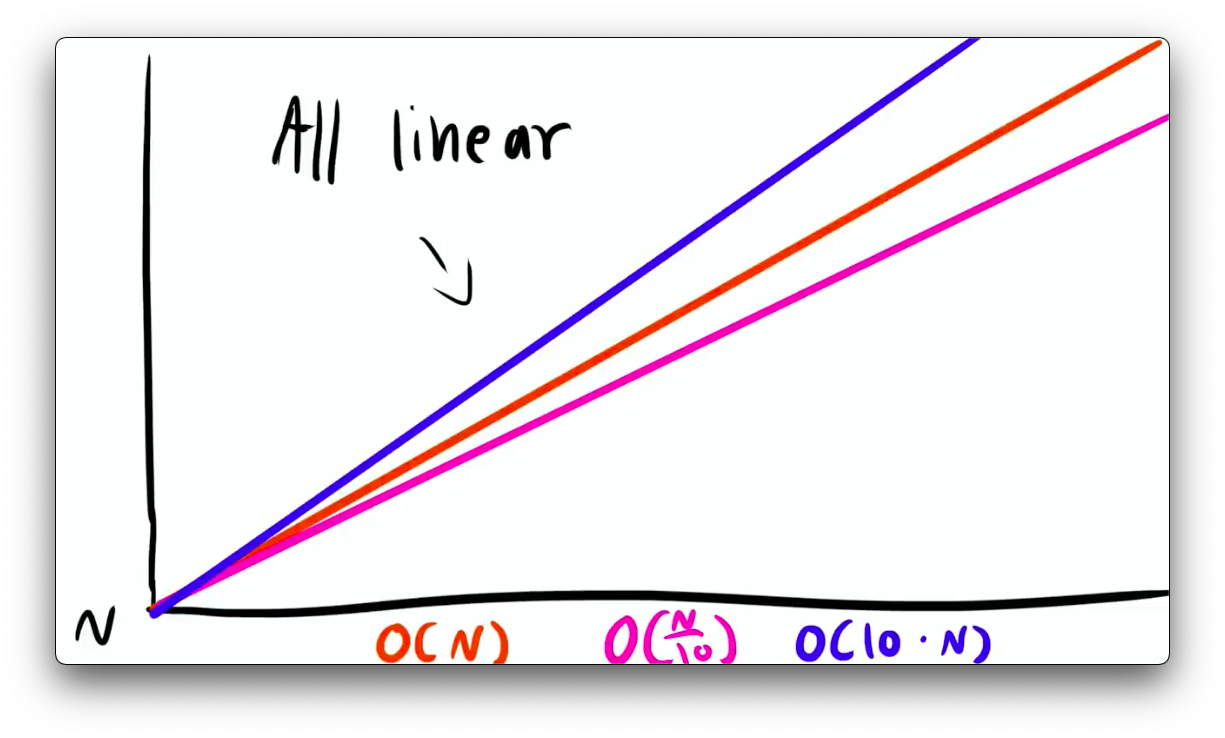 - -Big O Notation is also used for **space complexity**, which works the same way - *how much space an algorithm uses as n grows* or *relationship between growth of input size and growth of space needed*. - -So, yeah! This has been the simplest possible explanation of the Big O Notation from my side and I hope you enjoyed reading this. If you found this information helpful, share it with your friends on different social media platforms. It really motivates me to write more. And If you REALLY liked the article, consider [buying me a coffee](https://ko-fi.com/luciferreeves) 😊 - -***Happy Programming!*** diff --git a/_posts/2021-01-22-analysing-algorithms-worst-case-running-time.md b/_posts/2021-01-22-analysing-algorithms-worst-case-running-time.md deleted file mode 100644 index c15e1e9..0000000 --- a/_posts/2021-01-22-analysing-algorithms-worst-case-running-time.md +++ /dev/null @@ -1,197 +0,0 @@ ---- -layout: post -title: "Analysing Algorithms: Worst Case Running Time" -date: 2021-01-22 00:00:00 +0530 -author: Priyansh -tags: data-structures algorithms computer-science -usemathjax: true ---- -{% include math.html %} - -In my [last article](../big-o-notation-explained-as-easily-as-possible), I tried to give a beginner friendly explanation of the ***Big O Notation*** but we skipped out on a lot of stuff. So I am going to talk about **analyzing algorithms** today, specifically the ***worst-case running time of algorithms***, which indeed is the ***Big O***, while still keeping this article beginner friendly only. As we progress in the series, I would gradually start talking on higher levels and will try to discuss about most important factors of these concepts. - -One thing to keep in mind is that Big O is just a notation and can be used to denote a variety of things but we will stick to the worst case running time only in this article. - - -### Worst-Case Running Time is tricky... - -As you already know, we are focusing on the worst-case running times but even talking about worst-case running time can be tricky if we are trying to be precise. We have to identify the *worst case input* in detail, which can be counter-intuitive and then work through a lot of different cases. Also, if you followed the [last article](../big-o-notation-explained-as-easily-as-possible), we were counting the single operations or steps of different algorithms, which might get annoying as the algorithm becomes more and more complex. - - - -As we have discussed earlier too, that we drop the constants for the Big O notation (again, read the [last article](../big-o-notation-explained-as-easily-as-possible)) — so, if an algorithm has a running time of ***2n² + 23*** operations and another algorithm has a running time of ***2n² + 27*** operations (both for an input of size n), we wouldn't really care about the 23 or 27 — we would say that essentially they have the same running time. - - - -### Dropped Constants? Why? - -If you analyze the math correctly, you'll notice a big flaw with what I just said about dropping the constants. According to the statement I made above, an algorithm with a running time of 10000n and another algorithm with a running time of n, would have the same running time, according to the Big O notation, i.e. *O(n)*. But, any first grader can argue that, a function which takes 10000n time units to run is way slower than a function which takes n time units to run. - -The fact that the functions are both O(n) doesn't change the fact that they don't run in the same amount of time, since that's not what Big O notation is designed for. Big O notation only describes the growth rate of algorithms in terms of mathematical function, rather than the actual running time of algorithms on some machine. - -Mathematically speaking, let us assume two functions `f(x)` and `g(x)` be positive for x sufficiently large. We say that `f(x)` and `g(x)` grow at the same rate as x tends to infinity, if - -$$ \displaystyle \lim_{x \to \infty} \frac{f(x)}{g(x)} = M \neq 0 \text{ (M is a finite non-zero number)}. $$ - -Now, let `f(x) = x²` and `g(x) = x²/2` then while `limit(x ⟶ ∞)f(x)/g(x)` is equal to 2. Therefore, x² and x²/2 have the same growth rate, and hence we can say **O(x²)** is equal to **O(x²/2)**. - - - -### Wait, but how do I calculate that running time? - -Yes I get you mate — you're tired of listening that running of this algorithm of this much and running time of that algorithm is that much, but you never got to know, how the heck they are even being calculated! So, in order to make you understand and at the same time keeping this very simple, we will go back to counting. We will count time units for every operation performed and we will stick to 3 small rules: - -- '**simple**' operations (*such as **adding** two numbers, **multiplying** them or executing an **if** or **for** statement*) take *1 time unit* - -- loops count as often they run (*for example, if you have a loop that executes a simple operation 100 times, that would count as 100 time units*) - -- memory access is free, i.e. *0 time units* (*example: reading a part of input or writing something to memory cell*) - - - -In order to understand the above steps, let's look at some examples. Look at the lines of code below and try to guess how many time units would this code chunk takes to execute: - -```python -a = 1 -b = 2 * a -``` - -So, the answer here is that the machine is going to take just a single time unit (one time unit) to execute these two lines of code because line `a = 1` is just a memory access and we get memory access for free. The second line performs a simple operation, which takes 1 time unit. - - - -Now, let's try a little more challenging example. It's not really challenging but a little more difficult than the first one. Look at the code below and try to find the number of time units and note that the comparison `while s > 0` counts as a simple operation: - -```python -s = 5 -while s > 0: - s = s -1 -``` - -If your answer is 11 time units then you're right! The first line `s = 5` is free as it is a memory access. Then the second line is executed 6 times as **s** starts at 5 then it becomes 4, 3, 2, 1 and 0 which takes 6 time units. Finally, the last line is executed 5 times which takes 5 time units – bringing the total to 11 time units. - - - -### Running time vs Structure - -So, as you can see, exactly counting the number of time units even though we have a very simple model of just 3 rules and a code that doesn't even have a variable input is already quite tedious. That's why we introduce some additional simplifications (*Spoiler: Approaching the Big O!*) that gives us a little bit levy here so that we don't have to through this exact counting process but still learn about the algorithm. - - - -Now, you already know that the ***running time of an algorithm varies according to the size of the input (n)*** but the ***running time can also change with the content or structure of the input***. Let's explain this with an example. Our algorithm takes a string `s[0] to s[n-1]` i.e., a string of length n and it counts the number of times the character 'a' appears in the string by looping over the string and if it finds the character 'a', it would increase the counter. As discussed earlier, we are going to take the `for character in s:` line as a simple operation (takes *1 time unit* each time it is executed) and we are also going to consider the comparison `if character == 'a'` as a simple operation. Now, for the last time, I want you to count the number of time units taken by the code to execute. (*Hint: you need to take two variables into account: **n - length of the string** and the **a - denotes the number of times that the character 'a' actually appears in the string s**.*) - -``` -INPUT: String s[0]...s[n-1] // string of length n -``` - -```python -count = 0 -for character in s: - if character == 'a': - count = count + 1 -``` - -There's actually two correct answers here depending upon how you think about it. Both answers have **2n + 1a** in common and depending upon how you count the `for character in s:` line, the answer would be either **2n + 1a + 0** or **2n + 1a + 1**. So, let's discuss, why? The first line `count = 0` obviously takes 0 time units. The second line either takes **n time units** if you assume that the for loop goes exactly through each character of the string and then stops immediately or it takes **n + 1 time units** if you assume that it executed like a regular for or while loop. This again shows that it can be very annoying to do exact time counting. The next step though, is always executed **n times**. And finally, the counter is always increased when the algorithm encounters an 'a', so that is executed exactly **a times**. If you sum up, you get either **2n + 1a + 0** or **2n + 1a + 1** as your answer. - - - -Let's assume for now, that the running time of the above algorithm is **2n + 1a + 1**. As you've noticed, even for this simple algorithm, the running time depends on both the size of the inputs and the structure of the input, which in this case, is the number of times the letter 'a' occurs. This is of course very problematic because on the one hand when we get more complicated algorithms the formula (*here: 2n + 1a + 1*) is going get very complicated and secondly, we don't even know what kinds of strings the algorithm will encounter, so we cannot get rid of this variable **a** without making any assumptions. - - - -Based upon all this information, we can take 3 kinds of views with regard to our running time: - -1. Optimistic View - **Best Case Scenario** - *when we will not encounter any number of the letter 'a' in our input, i.e. the running time becomes **2n + 1**.* - -2. Average View - **Average Case Scenario** - *Gosh, how do we even define an average input?* - -3. Pessimistic View - **Worst Case Scenario** - *when all the characters of the string s are 'a' - that means we have n number of a's (or a = n) i.e. the running time becomes 2n + 1n + 1 or **3n + 1**.* - - - -So, which one of the three are we going to choose? Best case running time is often rather trivial or meaningless. For example, if we use best case running time for our algorithm that counts the number of a's, it would only be valid for strings that contain no 'a' at all – we can't take this. The average case view, could be very interesting view and practice because we run the algorithm a couple of times, we might not care about how much that algorithm runs in a single run but over many inputs. But, as I told you earlier, its hard to define what an average input looks like so as interesting the average case looks like, it is not suitable here. We will **always assume that the algorithm receives the input that makes it run as long as possible** because it offers *guarantees* — by taking a worst-case view, we know that our algorithm would not run longer than what the worst-case analysis suggests, no matter what happens! - - - -### Understanding Big O - -Let's consider two different algorithms, Algorithm A with a running time of **3n² -n + 10** and Algorithm B with running time of **2ⁿ - 50n + 256**. So, when you compare both of these algorithms, you can easily overlook the numbers 10 and 256 because those are just constants. Also we don't really care about the -n or -50n because we just look at the growth of 2ⁿ vs 3n². And even 3 is not relevant here in 3n² because even if we had 5n² or 6n² or even 100n², 2ⁿ would still grow much faster (*Why? Get a basic mathematics book and find out!*). - - - -So, what did we just do when we determined that the running time of Algorithm B grows much faster than the running time of Algorithm A? Well, first of all, we said that there was some value of n (*some value for the size of the input*) where the Algorithm B's running time function is always larger than Algorithm A's running time function. So, considering the running time of Algorithm A is some function `f(n)` and the running time of Algorithm B is some function `g(n)` and if `g(n)` grows faster than `f(n)` then there must be some value of n for which `g(n)` is larger than `f(n)` and for any value larger than that, the same should also be true (***g(n) > f(n)***) — Let's call that value `n'`. Based on all of this, we can conclude that: - -1. There is some number `n'`, so that `g(n') ≥ f(n')` - -2. For any `n'' > n'`, we have `g(n'') ≥ f(n'')` - - - -Now, I also said that we do not want to care about constants — so we do not want to care about if `f(n)` starts with 3n² or 5n² — we would just say that the function `f(n)` basically grows depending upon n². So, in order to do that we need another number, a constant `c` to be multiplied to `g(n)` that would allow to scale the function `g(n)` – basically speaking, if we can multiply the function `g(n)` with some number so that it outgrows `f(n)` then we would still be satisfied. Then we would say that `g(n)` grows at least as fast as`f(n)`. So the first statement can be restated as: - - - -*There is some number `n'c`, so that `c.g(n') ≥ f(n')`* - - - -It can also be said that, `f(n)` is contained in Big O of `g(n)` and is represented as `f(n) ∈ O(g(n))`. So, **Big O means that `g(n)` is a function that grows at least as fast as `f(n)`**. - - - -### Recognizing Bounds using Big O - -Big O notation is very useful because we can use it to concentrate just on the fastest growing part of a function and even without all the involved constants. Now let's focus on some example, so that you learn to recognize these bounds correctly. - -1. 3n + 1 ∈ O(n) — *obvious, meh* 🤷🏻♂️ - -2. 18n² - 50 ∈ O(n²) — *meh again* 🤷🏻♂️ - -3. 2ⁿ + 30n⁶ + 123 ∈ O(2ⁿ) — *as 2ⁿ grows faster than n⁶* - -4. 2ⁿ.n² + 30n⁶ + 123 ∈ O(2ⁿ.n²) — *2ⁿ.n² being the fastest growing function* - - - -> **FUN TRIVIA**: Big O notation is also sometimes called the **Landau Notation**, named after the German mathematician, ***Edmund Landau*** — he didn't actually invent the notation. It was done by another German mathematician called ***Paul Bachman***, but he popularized it in the 20th century. In a way, this is quite ironic because Edmund Landau was actually known as one of the most exact and pedantic mathematicians. His goal was uncompromisingly rigorous. Even in his lectures, he used to have an assistant who was instructed to interrupt him if he even omitted the slightest detail. It is interesting that he introduced a notation that omits all the details. - - - -### Running time using Big O Notation - -So, now that you've learnt the basics about Big O and Worst Case Analysis, let's take a look at another example and try to calculate the running time. But this time, we will use the Big O! So, this time we are using a similar example as earlier but instead of counting number of times the letter 'a' appears in the string, we are counting the number of times the sequence 'ab' appears in the string. - -``` -INPUT: String s[0]...s[n-1] // string of length n -``` - -```python -count = 0 -for i in range(n - 1): - if s[i] == 'a': - if s[i+1] == 'b': - count = count + 1 -``` - -As you remember, this was painful to do as we had to manually count everything. But now that we have the Big O notation available, our task is much easier because we can just make two observations and will be able to state the running time. So the first observation you make is that the algorithm will actually go through the string one by one, and since it always looks at a single character and the next character, **the algorithm will look at each character in the string at most twice**. And the second thing to notice is that each time the algorithm does consider a character, it will perform a constant number of operations — so if it finds an 'a' it would either do one or two operations and if doesn't find an 'a', it would do zero operations — and this is an advantage, because we can ignore the constants while using the Big O notation. So overall, this means if you have an input of length n, the algorithm will perform a number of steps that is some constant times n plus some constant for all the rest of the operations, i.e., **c₁.n + c₂** which indeed ∈ O(n). - - - -Let's consider one more example and try to find out the running time of this code: - -```python -result = 0 -for i in range (0, n): - for j in range(i, n): - result = result + j -``` - -And the answer for this is O(n²). So let's discuss, why! The first line is a memory access, so its free. As discussed earlier, second line is going to be executed either n or n + 1 times – that doesn't make any difference as we are using the Big O now, so the second line is executed *n times*. Now, we need to find out how often the inner loop is executed. So, the first time, it's actually executed n times, then the next time it is going to be executed n-1 times and so on and so forth because as the value of **i** increases the inner loop is executed less and less times. So, the total times the inner loop is executed is `n + (n-1) + (n-2) + ... + 2 + 1` which is equal to \\( \frac{n^2 + n}{2} \\) . And again, we can ignore the 2 in the denominator making it equal to \\( n^2 + n \\). So the complete total is n² + 2n ∈ O(n²). - - - -### Time to take a leave now... - -That was a long article — I hope you didn't get bored reading that. Well, once again, this is point where I beg you for following the blog. If you found this information helpful, share it with your friends on different social media platforms. It really motivates me to write more. And If you REALLY liked the article, consider [buying me a coffee](https://ko-fi.com/luciferreeves) 😊 - -***Happy Programming!*** diff --git a/_posts/2021-02-02-most-beautiful-question-of-computer-science-math.md b/_posts/2021-02-02-most-beautiful-question-of-computer-science-math.md deleted file mode 100644 index 3d6a558..0000000 --- a/_posts/2021-02-02-most-beautiful-question-of-computer-science-math.md +++ /dev/null @@ -1,93 +0,0 @@ ---- -layout: post -title: "Most Beautiful Question of Computer Science (+Math)" -date: 2021-02-02 00:00:00 +0530 -author: Priyansh -tags: data-structures algorithms computer-science -usemathjax: true ---- -{% include math.html %} - -Most beautiful question? Is that a click bait? Well, of course it is — beauty is present in the mind of the perceiver and not in the outside world. (*Damn it! That's some life changing philosophy!*) - -So, coming to the question again, today I am going to introduce you to one of my favourite and as I said most beautiful beginner friendly questions that you will encounter in Computer Science (and also Mathematics). You guys, ready? Here it goes: - - - -Now I really like this question because it sounds so absurd in the beginning, right? Its almost as if I am saying that I have 4 mangoes and I give 2 of them to John. Now calculate the mass of the sun! Anyways, you can stop reading here and try to solve it, but let go through the explanation of the solution for this question. - -So, the basic idea is to randomly draw points in a 1:1 square (a square with a side of unit length) or a 1:1 grid. Then, you can call the `random()` function twice, so you get two numbers and you can use one for the x-axis and one for the y-axis (*example: x = 0.2 and y = 0.6*) and you can generate a whole lot of these. - - - -So now, I am going to give you a hint. I am gonna draw something and you'll probably know how to do this. - - -Got it? No? Let's elaborate a little more then! - -As you can see, the goal here is count all the points in the circle and count all the points in the square. The ratio between these numbers would be pretty close to the ratio between the total area of the circle and the area of the square. - - - -So, how do you know if a point is in the circle or not? Well, it is very simple. You just take the distance between point and the origin and if it is smaller than 1, it is inside the circle. So, what would be the distance of a point at co-ordinates `(x, y)` from the origin? The distance is: - -$$ distance = \sqrt{x^2 + y^2} $$ - -If the above distance is < 1 than it is inside the circle and if it is > 1 than it is outside the circle but still inside the square. So, now it's basic algebra from here. As we all know that the area of a circle is \\( \pi r^2 \\) (considering the radius of the circle is *r*) — oh, you didn't knew? Hmph, fucking idiot! And then, in this case, the area of the square will be \\( (2 \cdot r)^2 \\). And this ratio would be equal to the ratio of number to points in the circle and the total number of points. - -$$ \frac{\pi r^2}{(2\cdot r)^2} = \frac{\mathrm{number\:of\:points\:in\:the\:circle}}{\mathrm{total\:number\:of\:points}} $$ - -Now we need value of \\( \pi \\), so that would be pretty easy as we know, \\( r = 1 \\) here. Therefore: - -$$ \pi = \frac{4 \cdot \mathrm{number\:of\:points\:in\:the\:circle}}{\mathrm{total\:number\:of\:points}} $$ - -So, yeah! That's pretty much it. Coding it should be pretty easy, so I am not going to go over that. - -Wait! I changed my mind. I think I am going to show the code as it can explain things a *little* bit better. So, I am going to define a function called `estimate_pi` and it takes an input of `n` — n being how many points you want to put in — the more points the more accurate the result is. And then I will initialise the number of points in the circle and total number of points - both to zero. Mind that the code shown here is in python but you can easily translate it to any other language of your choice. - - -```python -def estimate_pi(n): - num_point_circle = 0 - num_point_total = 0 -``` - -So, now we just want to keep looping and keep adding these points. So we loop over n times and on every iteration, we generate two random numbers x and y — and then we will calculate the \\( distance = \sqrt{x^2 + y^2} \\) but we can actually drop the square root because what we care about is if the distance is smaller than 1, and if you square root something smaller than 1, it would be smaller than 1 and if you square root something bigger than 1, it is going to be bigger than 1. So if the distance is smaller than 1, then it is inside the circle and we will increase `num_point_circle` by 1 and we would also increase `num_point_total` by 1, no matter what. - -```python -def estimate_pi(n): - num_point_circle = 0 - num_point_total = 0 - -for _ in range(n): - x = random.uniform(0,1) - y = random.uniform(0,1) - distance = x**2 + y**2 - if distance <= 1: - num_point_circle += 1 - num_point_total += 1 -``` - -Finally you can return `return 4*num_point_circle/num_point_total` as your result and don't forget to import the `random` library. So the whole code looks like: - -```python -import random - -def estimate_pi(n): - num_point_circle = 0 - num_point_total = 0 - for _ in range(n): - x = random.uniform(0,1) - y = random.uniform(0,1) - distance = x**2 + y**2 - if distance <= 1: - num_point_circle += 1 - num_point_total += 1 - - return 4*num_point_circle/num_point_total -``` - -Here, you can see that I have run the `estimate_pi` function a few times with different sizes of n and as we use more and more data points, we get a value closer to actual pi. Although, it would be very hard to determine the exact value of pi. If you want to try the code for yourself, you can view my repl here: [https://repl.it/@luciferreeves/SpottedTechnicalReality](https://repl.it/@luciferreeves/SpottedTechnicalReality) . - - -Well, that's it for this article guys! If you found this information helpful, share it with your friends on different social media platforms. It really motivates me to write more. And If you REALLY liked the article, consider [buying me a coffee](https://ko-fi.com/luciferreeves) 😊 diff --git a/_posts/2021-07-27-do-you-really-know-javascript.md b/_posts/2021-07-27-do-you-really-know-javascript.md deleted file mode 100644 index 71aa2ea..0000000 --- a/_posts/2021-07-27-do-you-really-know-javascript.md +++ /dev/null @@ -1,234 +0,0 @@ ---- -layout: post -title: "Do You Really Know JavaScript?" -date: 2021-07-27 00:00:00 +0530 -author: Priyansh -tags: programming javascript computer-science -usemathjax: false ---- - -A lot has changed in the world of JavaScript – whether you are a newbie or an expert in JavaScript, you might not be able to get a hold on all the things that are possible in JavaScript. JavaScript is a lot more than you think and having some nifty ES6 tricks on your fingers could really save you both time and code complexity. - -I'm going to cover a few things you should be absolutely be using on a daily basis while you are programming in JavaScript and if you are serious about a future in JavaScript development, you will find these a really good add-on to your current knowledge. So, in order to explain things a lot better, we are going to cover this lesson through two versions of examples – one, the way people regularly write code – which is correct but inefficient and the second, the awesome way. - -So, let's start! - -## 1. The Spread Operator - -Okay, here's the task we wan't to accomplish - There are two arrays called 'array1' and 'array2' (Not so good names but I wasn't able to come up with something really good. So, I guess that's a drat!) We want to push all the elements of array1 to array2. So, how do we achieve it? - -### The Amatuer Way - - -```js -let array1 = ["one", "two"]; -let array2 = ["three", "four"]; - -for(var i=0; i<array1.length; i++) { - array2.push(array1[i]); -} -``` - -Hmm, the above code does it, doesn't it? Yeah but wait till you look at the awesome way! - -### The Awesome Way - - -```js -let array1 = [ 'one', 'two']; -let array2 = ['three', 'four', ...array1]; -``` - -Woah, that was really awesome. It made things really simple. So, now that you're thinking what's that three dots? Those three dots is called a **spread operator** and is represented by `...` before an object or an array and it turns something from being a structure into a comma-separated list! - -So, now that we tackled arrays, we can use the same syntax for targeting objects. - -```js -const hero = { - name: 'Naruto', - jutsu: 'Shadow Clone Jutsu' -} - -const heroWithAdditionalJutsu = { - ...hero, - additionalJutsu: 'Rasengan' -} -``` - -## 2. String Interpolation - -Have you ever tried to **concatenate** multiple strings in JavaScript which has a lot of different variables? Take a look at the `getDescription()` method below – it's a long, multiline, hard-to-read statement. This is a reality in most programming languages. - -### The Amatuer Way - - -```js -class Product { - constructor(name, description) { - this.name = name; - this.description = description; - } - - getDescription() { - return " Full description \n" + - " name: " + this.name + - " description: " + this.description - } -} -``` - -With a little nifty trick, We can turn our `getDescription()` method into the following: - -### The Awesome Way - - -```js -getDescription() { - return `Full description \n: - name: ${this.name} - description ${this.description} - `; -} -``` -So double backticks (`` ` ``) is what we use to define a multi-line string. We are also able to use `${}` to **interpolate**. There it is! Hopefully, your world is a little better now :) - -## 3. Shorthand Properties - -If you ever wanted to return a JSON object in your code, you're probably doing this: - -### The Amatuer Way - - -```js -function returnCoordinates(x, y) { - return { - x: x, - y: y - } -} -``` - -But, did you know if your property names and the variable names are the same, you can completly omit the `:` and you would end up in this: - -### The Awesome Way - - -```js -function returnCoordinates(x, y) { - return { x, y } -} -``` - -You can use the similar approach while you are defining **method properties**. So, something like this: - -```js -const mathFunctions = { - add: function(a,b) { return a + b; }, - sub: function(a,b) { return a - b; }, - multiply: function(a,b) { return a * b; } -} -``` - -Would become this: - -```js -const mathFunctions = { - add(a,b) { return a + b; }, - sub(a,b) { return a - b; }, - multiply(a,b) { return a * b; } -} -``` - -Awesome, isn't it? ;) - -## 4. Destructuring - -Have you ever encountered a case where we want to dig out data from an object at different levels and you probably end up doing something like this? - -### The Amatuer Way - - -```js -const name = req.body.name; -const description = req.body.description; -const url = req.url; -``` - -Just think of the situation where you might have 20 or even worse case scenario, 50 objects like this. You won't go up writing 50 lines of code, right? Fortunately **Destructuring** is here to save you. All of the above operation could be performed in a single line of code. - -### The Awesome Way - - -```js -const { body: { name, description }, url }, = req; -``` - -Yeah! That's it boy! - -## 5. Promises & Async/Await - -If you have been around the block a while you might remember a time when callbacks were all we had, like this: - -### The Amatuer Way - - -```js -function doSomething(cb) { - setTimeout(() => { - cb('done') - }, 3000) -} - -doSomething((arg) => { - console.log('done here', arg); -}) -``` - -We used this to handle the fact that some operations were asynchronous and simply took time to finish. Then we got promise libraries that people started using and eventually, we got native support in the language. So now we can do things like: - -### A Little Better But Still Amatuer Way - - -```js -function doSomething() { - return new Promise((resolve, reject) => { - setTimeout(() => { - resolve('done') - }, 3000) - }) -} - -doSomething().then(arg => { - console.log('done here', arg); -}) -``` - -We can even chain the whole experience so we can do calls like this: - -```js -getUser() - .then(getOrderByUser) - .then(getOrderItemsByOrder) - .then(orderItems => { - // do something with order items - }) -``` - -Then we got **async/await** and life became even more glorious. Consider the above example with **Promises** now becoming this: - -### The Awesome Way - - -```js -async function getItems() { - try { - const user = await getUser(); - const order = await getOrderByUser(user); - const items = await getOrderItemsByOrder(order); - return items; - } catch(err) { - // handle error here, the suggestion to return something or rethrow - } -} - -getItems().then(items => { - // do something with order items -}) -``` - -And we get a synchronous-looking asynchronous code. Heck, yeah! :) - -## Summary - -There are more things I could mention about **ES6** and forward but I just wanted to show you a few of my favorites. I hope you have learnt something great today that I think you should adopt and bring these into practice. I also hope you continue to expand your knowledge of JavaScript and create something great someday! - -Well, that's it for this article guys! If you found this information helpful, share it with your friends on different social media platforms. It really motivates me to write more. And If you REALLY liked the article, consider [buying me a coffee](https://ko-fi.com/luciferreeves) 😊 diff --git a/about.md b/about.md deleted file mode 100644 index 31e9227..0000000 --- a/about.md +++ /dev/null @@ -1,19 +0,0 @@ ---- -layout: post -title: About -permalink: /about/ -author: Priyansh ---- - -This is the base Jekyll theme. You can find out more info about customizing your Jekyll theme, as well as basic Jekyll usage documentation at [jekyllrb.com](https://jekyllrb.com/) - -You can find the source code for Minima at GitHub: -[jekyll][jekyll-organization] / -[minima](https://github.com/jekyll/minima) - -You can find the source code for Jekyll at GitHub: -[jekyll][jekyll-organization] / -[jekyll](https://github.com/jekyll/jekyll) - - -[jekyll-organization]: https://github.com/jekyll diff --git a/index.html b/index.html deleted file mode 100644 index 0671507..0000000 --- a/index.html +++ /dev/null @@ -1,6 +0,0 @@ ---- -# Feel free to add content and custom Front Matter to this file. -# To modify the layout, see https://jekyllrb.com/docs/themes/#overriding-theme-defaults - -layout: home ---- |